Automating Attention
Why reliable follow-up is not just automation, but accuracy
Summary
A properly designed automation policy turns follow-up from a memory problem into a process solution. When the rules are clear, the system can make sure attention is delivered accurately, consistently, and respectfully.
We recently added a deceptively simple feature to Uniti.
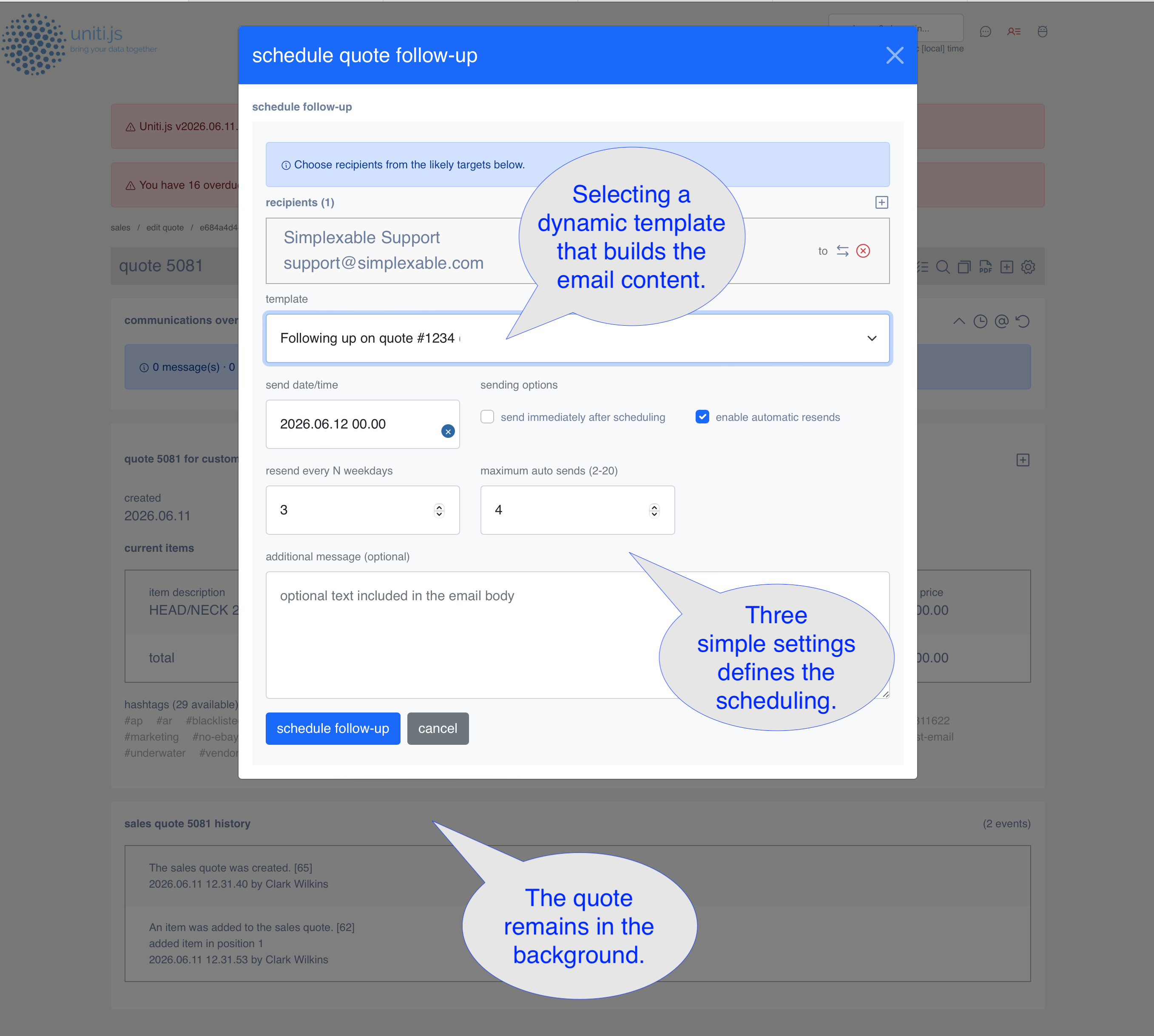
When a quote is sent to a customer, the system can now attach a follow-up policy.
For example:
Every 3rd weekday. Up to 4 follow-ups. Stop immediately if the customer opts out.
That's it.
Three settings.
But those three settings fundamentally change how attention is managed.
In our spare parts business, we send quotes all the time. A customer asks for something. We identify the part. We prepare the quote. We send it.
Then the real problem begins.
Someone intends to follow up.
Then another quote arrives. A shipment needs attention. The phone rings. The day gets away from them.
The opportunity was not lost because anyone made a bad decision.
It was lost because attention is imperfect.
So before we built anything, we needed a policy.
PERSISTENT. ACCURATE. RESPECTFUL.
This is just one process, but it's the one that runs every time — without ever being dropped.
The system is not deciding what to do.
Humans already made that decision when they defined the policy.
The system is simply executing it faithfully.
That distinction matters.
This is not an email scheduler.
This is not a reminder list.
It's the contract the system enforces every time a quote enters the follow-up path.
Once you define the process this tightly, certain implementation decisions are no longer optional.
The follow-up interval has to be explicit.
The maximum number of touches has to be explicit.
The opt-out path has to be immediate.
And the history has to be recorded.
So the automation wasn't a design flourish. It was a consequence.
Most businesses already know how often they should follow up.
The problem is not deciding. The problem is remembering.
The simplicity is the point.
Most businesses already know how often they should follow up, and they know the context that needs to tailor these settings to each client/situation.
What they lack is a mechanism that guarantees the follow-up actually happens.
In Uniti, the policy can be expressed in plain business terms:
“Send this quote every X weekdays, up to Y times.”
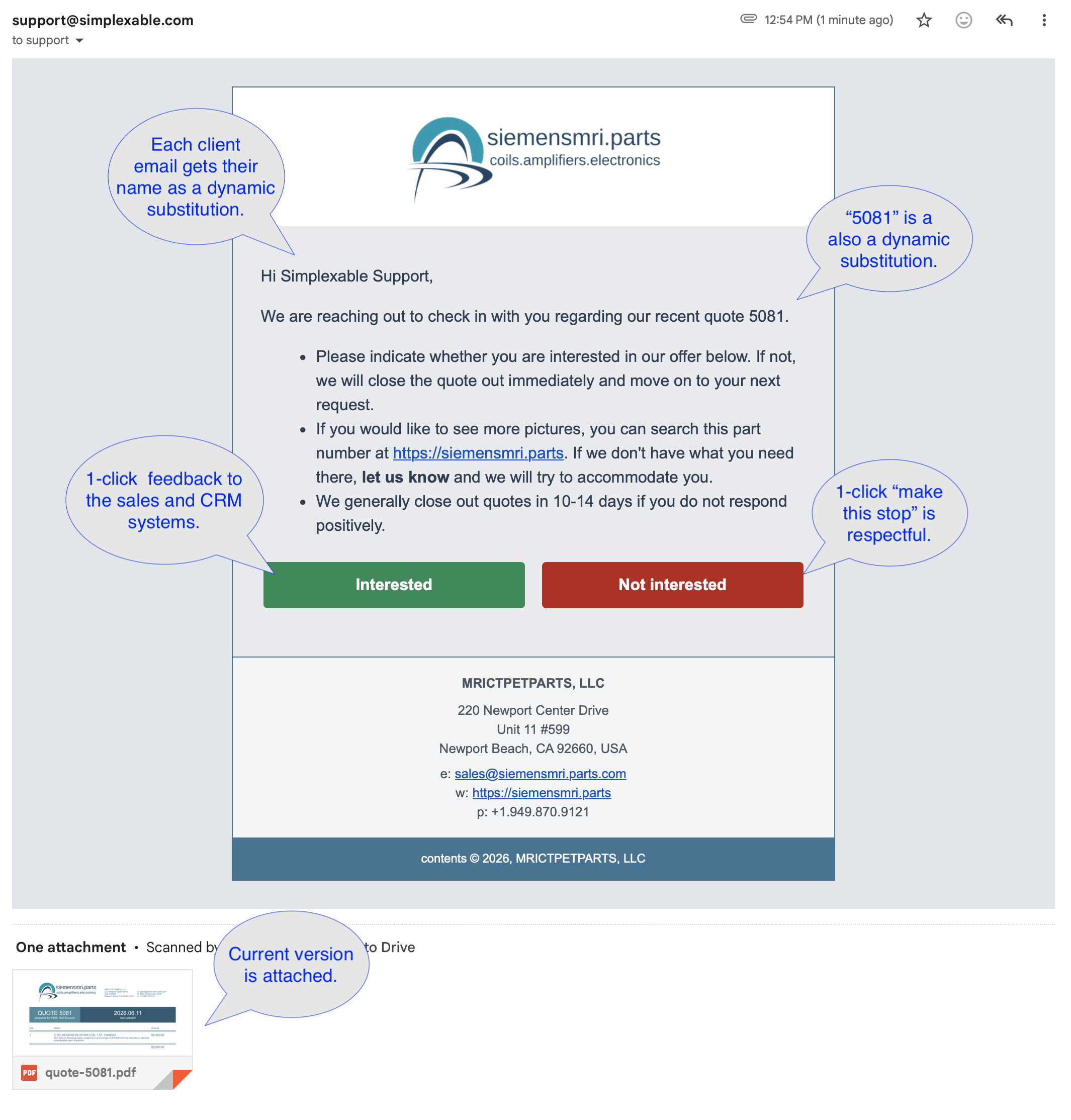
If the customer clicks the red opt-out button, shut it down.
That is simple enough to understand in one sentence, and powerful enough to eliminate a recurring failure mode.
That last part is essential.
Automation should not mean harassment.
The system is allowed to be persistent because the customer remains in control.
One click stops the sequence. No negotiation. No hidden preference page.
No pretending that "unsubscribe" is a mystery.
Persistent. Accurate. Respectful.
Automated attention is accurate attention.
The value of automation is not merely that it performs work.
The value is that it performs the work the same way, every time.
- Humans forget.
- Humans get interrupted.
- Humans go on vacation.
- Humans mean well.
But a properly designed automation policy executes exactly as specified.
That is where the accuracy comes from.
- The salesperson still writes quotes.
- The salesperson still answers questions.
- The salesperson still negotiates.
- The salesperson still builds relationships.
The computer remembers. The human decides.
Most business software is designed to store information.
Customers. Orders. Invoices. Inventory. But information is only half the story.
Attention matters too.
A quote that receives consistent follow-up is more valuable than a quote that is forgotten.
A lead that receives timely attention is more valuable than a lead that sits untouched.
A process that executes consistently is more valuable than one that depends on memory.
This is what happens when you don't just say "send a reminder", but instead, "encode this attention policy".
The actual code is an implementation detail.
The important work was deciding what should always happen.
Automated attention is accurate attention.
Clark Wilkins
Chief Improviser
Simplexable LLC