There’s Much More to Feel Than Just the “Vibe”
Process design, interface design, and why AI still needs a system to build
Summary
“Vibe-coding” is not going to deliver excellence by itself. The art of process design, and indeed, interface design, requires knowing what really needs to be built, and how to do it.
We recently set out on a “little” side project that ended up taking 3+ weeks, 39 major phases, and at least 100 commits.
We wanted to expand the way our parts business, siemensmri.parts, handles parts requests we get where we don’t have the item. The process of reaching out to our network, to see who might be able to supply the need, is called “sourcing.” So we needed a Sourcing Portal.
But first, we needed a plan. I began by laying out the basic path for the sourcing process:
FAST. CLEAR. RESPECTFUL.
This is just one process, but it’s the one that runs every time.
It has to be fast, clean, and so well-structured that anyone can understand what to do—and more importantly, can feel how efficient and respectful it is.
That’s how you signal seriousness.
This is not a job for vibe-coding.
This is not a UI flow.
It’s the contract the system enforces every time a request enters it.
Once you define the process this tightly, certain implementation decisions are no longer optional.
So the email wasn’t a design exercise. It was a consequence.
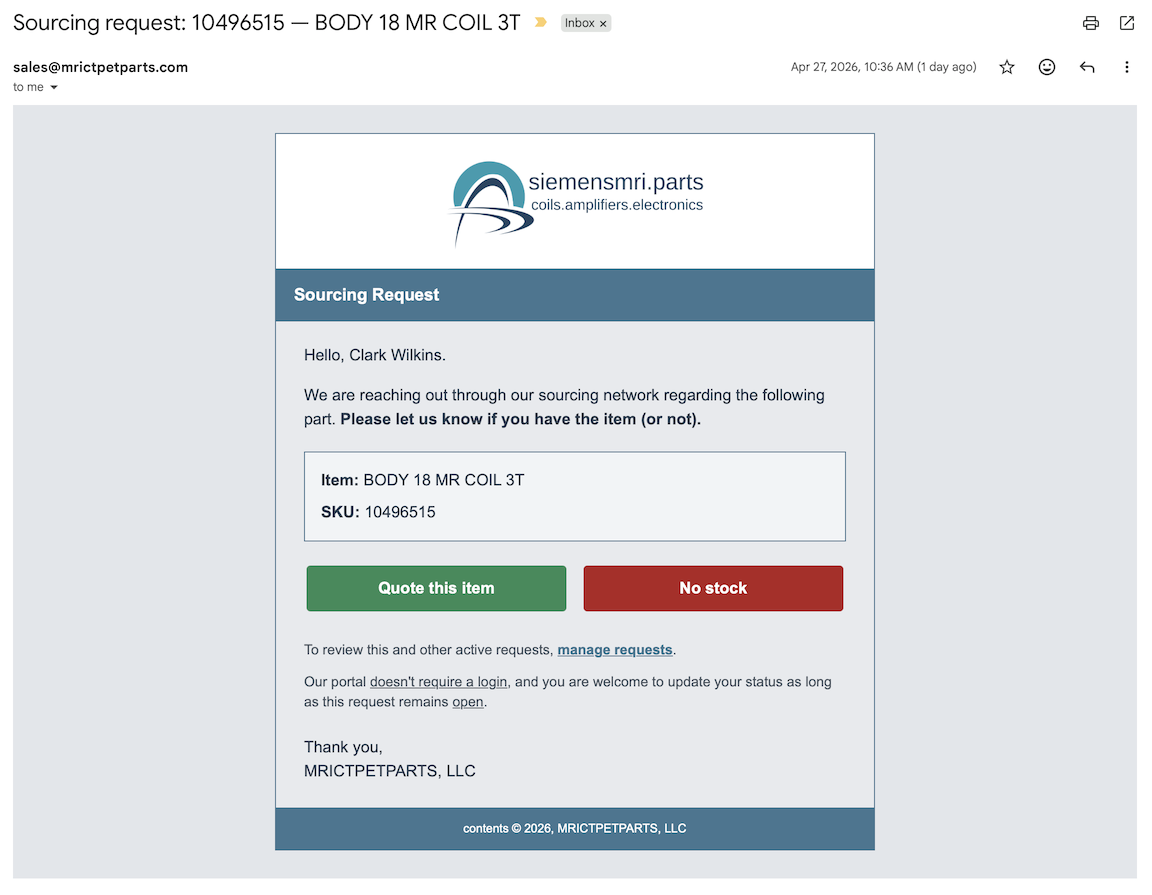
The vendor sees exactly what we need in the subject line and the body text. We provide two clear options, and “No stock” is a one-click action that closes out this request.
We designed this for vendors who might get 30–40 requests a day. This has to be fast and tight: 15 seconds or less was our goal.
If the vendor doesn’t have the item, they’re all done. If they do, the process moves into quoting.
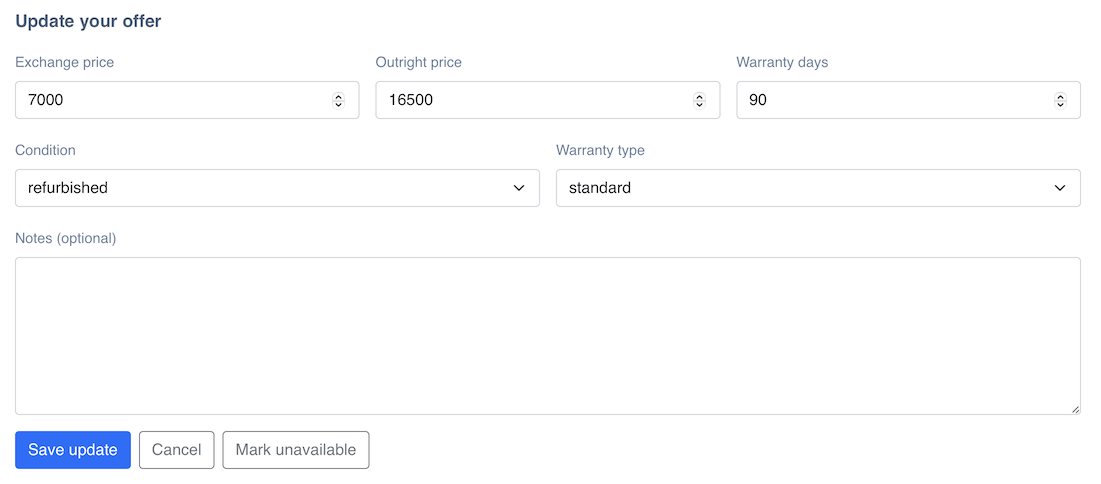
Five fields define the minimum input from the first diagram.
The vendor makes the quote and moves on.
The portal sends them two critical emails.
The first one memorializes their quote.
The second email is one of two messages: “this is the best offer to date,” or “we have received a better offer, and you might want to adjust your quote.”
The system doesn’t just collect quotes — it continuously communicates position.
Feeling the vibe?
The portal is demonstrating respect for the audience, efficiency of information processing, and craftsmanship.
This is what happens you don’t just say “make me a thing”, but instead, “encode this system of rules”.
The actual code is an implementation detail, and, allowing for proper protection from bugs and edge cases, that’s suitable for vibe-coding.
Clean efficient interfaces that translate seamlessly from desktop to mobile, and don’t waste time — that’s design.
It's important to recognize that difference.
Design decisions are not driven by vibes, but by process analysis.
AI makes it possible to build more—and better—than we could before. But only if we know what we’re building.
Clark Wilkins
Chief Improviser
Simplexable LLC